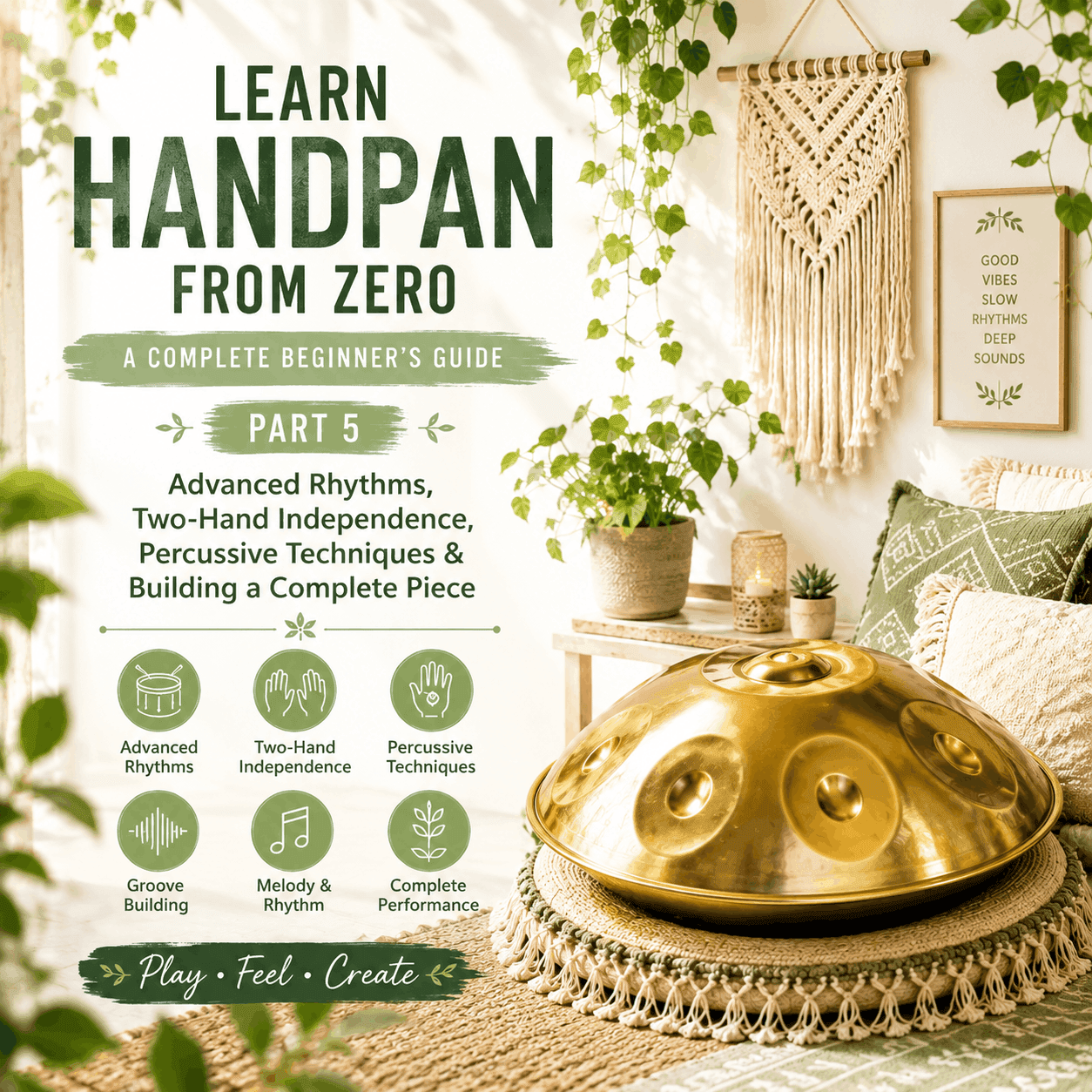
Welcome back!
In Part 1, you learned how to sit correctly, hold your hands naturally, strike the notes properly, and produce a clean sound. Now it's time to move beyond the basics and begin playing real music.
This guide will teach you how to improve your rhythm, timing, hand coordination, dynamics, and overall musical expression while avoiding the mistakes that slow down many beginners.
1. Build a Strong Sense of Rhythm
Rhythm is the foundation of every beautiful handpan performance.
Many beginners focus only on playing notes, but experienced musicians understand that timing is more important than speed.
Start by practicing with a slow pulse.
A metronome is one of the best tools you can use.
Practice at:
50 BPM
60 BPM
70 BPM
Only increase the tempo when every note sounds clean.
Try playing one note every beat, then two notes per beat, and finally simple rhythmic patterns.
Consistency is much more valuable than speed.
2. Learn to Alternate Your Hands
One of the biggest beginner mistakes is relying on the dominant hand.
Instead, alternate every stroke.
Example:
Right – Left – Right – Left
Then practice:
Right – Right – Left
Left – Left – Right
These exercises improve coordination and help both hands become equally comfortable.
Eventually, your movements will become natural and relaxed.
3. Practice Simple Rhythmic Patterns
Instead of randomly hitting notes, learn repeating patterns.
For example:
Bass note → Melody → Melody
Ding → Side note → Side note
Low → High → High → Low
Repeat each pattern for several minutes.
Repetition develops muscle memory.
4. Learn Dynamic Control
Playing every note with the same force makes music sound flat.
Good handpan players control volume naturally.
Practice playing:
Very soft
Medium
Loud
without changing the tone quality.
Imagine telling a story.
Some parts should whisper.
Others should speak confidently.
5. Control the Length of Each Note
Handpans naturally produce long sustain.
Sometimes you should let notes ring.
Other times you should stop them using your fingers or palms.
Experiment with:
Long resonance
Short notes
Mixed phrasing
This creates musical contrast.
6. Improve Hand Independence
Once basic coordination feels comfortable, give each hand a different role.
For example:
Left hand:
Maintain a steady pulse
Right hand:
Create melody
This develops independence and prepares you for more advanced playing.
7. Explore Different Playing Areas
Most beginners play only near the center of each tone field.
Experiment with different striking positions.
Small changes produce different colors:
Warm tone
Bright tone
Soft tone
Percussive tone
Always avoid hitting the note too hard.
The handpan responds best to relaxed movements.
8. Develop Musical Phrases
Music is made of sentences.
Instead of playing endless random notes, think in short phrases.
Play:
4–8 notes
Pause.
Let the instrument breathe.
Then continue.
Silence is also part of music.
9. Learn to Listen
One of the fastest ways to improve is careful listening.
Record your practice sessions.
Ask yourself:
Are the notes clean?
Is the rhythm steady?
Am I rushing?
Are both hands balanced?
Does the melody feel natural?
Listening objectively helps you improve much faster than simply practicing longer.
10. Create a Daily Practice Routine
Consistency beats long, occasional practice sessions.
A simple 30-minute routine:
5 minutes
Warm-up
5 minutes
Single-note accuracy
5 minutes
Alternating hands
5 minutes
Rhythm exercises
5 minutes
Improvisation
5 minutes
Playing your favorite melody
Practicing daily is far more effective than several hours once a week.
Common Beginner Mistakes
Avoid these habits:
Playing too hard
Sitting with tense shoulders
Ignoring rhythm
Looking at your hands constantly
Playing too fast
Skipping warm-ups
Practicing only favorite patterns
Holding unnecessary tension in the wrists
Small corrections today prevent bad habits tomorrow.
How to Improve Faster
Professional players improve because they practice intentionally.
Helpful habits include:
Record every practice session.
Use a metronome.
Practice slowly.
Focus on one skill at a time.
Learn from experienced players.
Play along with relaxing background tracks.
Join handpan communities.
Perform for friends and family.
Beginner Goals for the First Three Months
By the end of three months, aim to:
Produce consistently clean notes.
Keep steady rhythm.
Alternate hands comfortably.
Play simple grooves.
Improvise short melodies.
Feel relaxed while playing.
Understand your handpan's scale.
Don't compare yourself to professional performers.
Compare today's playing with yesterday's.
Progress comes from patience and consistent practice.
Final Thoughts
Learning the handpan is a journey rather than a race.
Beautiful music doesn't come from playing more notes—it comes from playing the right notes with feeling, intention, and control.
Every practice session builds confidence, improves coordination, and deepens your connection with the instrument.
Stay patient, enjoy the process, and remember that every experienced handpan player once started exactly where you are today.
Frequently Asked Questions (FAQ)
How long should I practice each day?
Twenty to thirty minutes of focused daily practice is ideal for most beginners.
Should I always use a metronome?
Yes. A metronome helps develop accurate timing and steady rhythm.
When should I learn new techniques?
Master clean sound and rhythm first. Strong fundamentals make advanced techniques much easier.
Is improvisation difficult for beginners?
Not at all. Start with just three or four notes and focus on rhythm instead of complexity.
What is the fastest way to improve?
Practice consistently, record yourself regularly, and focus on quality rather than speed.

-2_204.png&w=1920&q=75)
